July 23, 2026
What Is Banana Ball? The Savannah Bananas' Game, Explained
What is Banana Ball? A plain-English guide to the Savannah Bananas' two-hour, point-scoring, fan-friendly version of baseball — and how to watch it live.
If you have seen a clip of a Savannah Bananas player hitting on stilts, or an entire infield breaking into a dance routine between pitches, you have already met Banana Ball. It looks like pure chaos. It is not. Banana Ball is a real sport with a tight, deliberate rulebook — and once you know the rules, the chaos starts making a lot of sense.
Banana Ball in one sentence
Banana Ball is a faster, fan-first version of baseball created by the Savannah Bananas, built around a two-hour clock, a point-per-inning scoring system, and a set of rules designed to delete every dead moment from the game.
That last part is the whole idea. Traditional baseball has long stretches where nothing happens: mound visits, batters adjusting their gloves, pitchers pacing the mound. Banana Ball's rulebook goes after those gaps one by one. What is left is a game that moves constantly and almost never lets the crowd sit still.
Where Banana Ball came from
The Savannah Bananas launched in 2016 as a summer collegiate wood-bat team in the Coastal Plain League, playing out of Grayson Stadium in Savannah, Georgia. Owner Jesse Cole — the one in the yellow tuxedo — leaned into entertainment from day one: dancing players, on-field bits, and a promise that fans would never be bored.
The team introduced Banana Ball in 2020 as an experiment in speeding the game up. It worked. The format took off, and the Bananas eventually left collegiate baseball behind entirely to play Banana Ball full time and take it on the road, filling minor league parks and, before long, major league stadiums.
The rules that make Banana Ball different
These are the rules that actually change how the game gets played.
Every inning is worth one point
This is the big one. Banana Ball does not crown the team with the most total runs. Instead, each inning is worth a single point, and whichever team scores more runs in that inning takes the point. Win an inning 5–1 and you get one point — exactly the same as winning it 1–0.
The final inning is the exception: every run scored there counts. That means a team can be down several points and still storm back at the end, and it means no inning is ever a throwaway.
There is a two-hour clock
No new inning can start once the game hits the two-hour mark. Games are built to fit a tidy window, and the clock puts real pressure on both teams to keep things moving.
There are no walks
Ball four does not send the batter on a slow jog to first. It becomes a sprint: the batter takes off, and the defense has to get the ball around the field before the play is live. A walk in Banana Ball regularly turns into a double or better, which is a powerful incentive for pitchers to attack the zone.
Fans can catch you out
If a fan in the stands catches a foul ball, the batter is out. It is the only sport where buying a good seat makes you part of the defense — and it is a genuinely tense moment every time a foul goes up.
No bunting, and no stepping out of the box
Bunting is banned outright. And once a hitter steps into the batter's box, they stay there — stepping out is an automatic strike. Both rules exist for the same reason: they remove stalling.
The Golden Batter
Once per game, a team can send any hitter they want to the plate, regardless of where the lineup actually sits. Save it for the right moment and your best bat comes up with the game on the line. It is the closest thing Banana Ball has to a trump card.
It is a show as much as a game
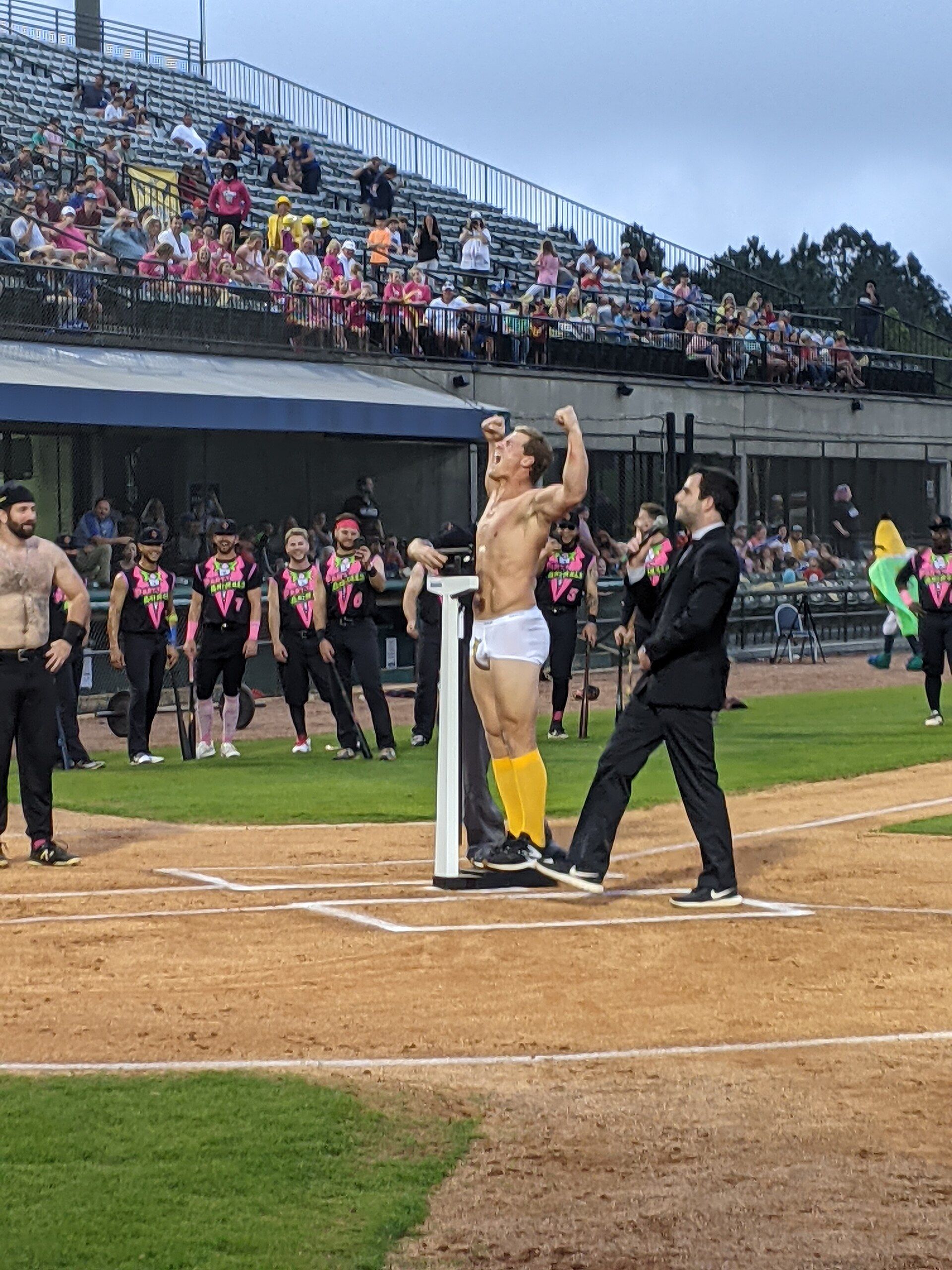
The rules are only half of it. A Banana Ball game runs like a variety show wrapped around a ballgame: choreographed dances, trick plays, players in costume, and bits running between innings. The performers are part of the roster, not a sideshow — the entertainment is scheduled as tightly as the innings are.
That is why people who do not follow baseball still buy tickets. You do not need to know what a slider is to have a good time.
Who actually plays Banana Ball
The Bananas do not barnstorm alone. Banana Ball is played by a small league of touring clubs — the Savannah Bananas, the Party Animals, and the rest of the squads on the circuit. Each team has its own identity and its own bits, and the rivalries are a real part of the draw. You can see every club and what makes each one different in our guide to the Banana Ball teams.
How to watch Banana Ball
Two paths: in person, or on a screen.
In person means planning ahead. The tour moves city to city, dates get announced in batches, and demand is high — check the full Banana Ball schedule to see where and when the teams are playing next.
If you cannot get to a stadium, games are streamed and broadcast in several places, and there are solid options for following scores live. Our where to watch Banana Ball guide breaks down the streaming and TV options.
FAQ
Is Banana Ball real baseball?
It is real, competitive baseball played under a different rulebook. The fundamentals — pitching, hitting, fielding — are the same. The scoring system, the clock, and the fan-interaction rules are what set it apart.
How long is a Banana Ball game?
Roughly two hours. No new inning can begin after the two-hour mark, so games stay inside a predictable window instead of running long.
How does scoring work in Banana Ball?
Each inning is worth one point, awarded to whichever team scores more runs in that inning. In the final inning, every run counts individually, which keeps comebacks alive right to the end.
Can fans really catch someone out?
Yes. A foul ball caught by a fan in the stands is recorded as an out.
What is the Golden Batter rule?
Once per game, a team may send any batter in their lineup to the plate out of order — usually saved for a high-leverage moment late in the game.
Where can I watch Banana Ball?
Games are available through streaming and broadcast partners, and tickets are sold for each tour stop. See where to watch for current viewing options and the schedule for upcoming games.
Photo: baseballmapper / Wikimedia Commons (CC0)
