June 29, 2026
Banana Ball Player Stats & Team Records: How to Read the Numbers
A plain-English guide to Banana Ball player stats and team records: what gets tracked, why the numbers look different from regular baseball, and where to find them live.
Banana Ball moves fast, the music never stops, and a guy on stilts might be on the mound. So it's fair to wonder: does anybody actually keep score? They do — and the stats tell a great story once you know how to read them. Here's a plain-English guide to Banana Ball player stats and team records, why the numbers look a little different from the box scores you grew up with, and exactly where to find them.
How team records actually work in Banana Ball
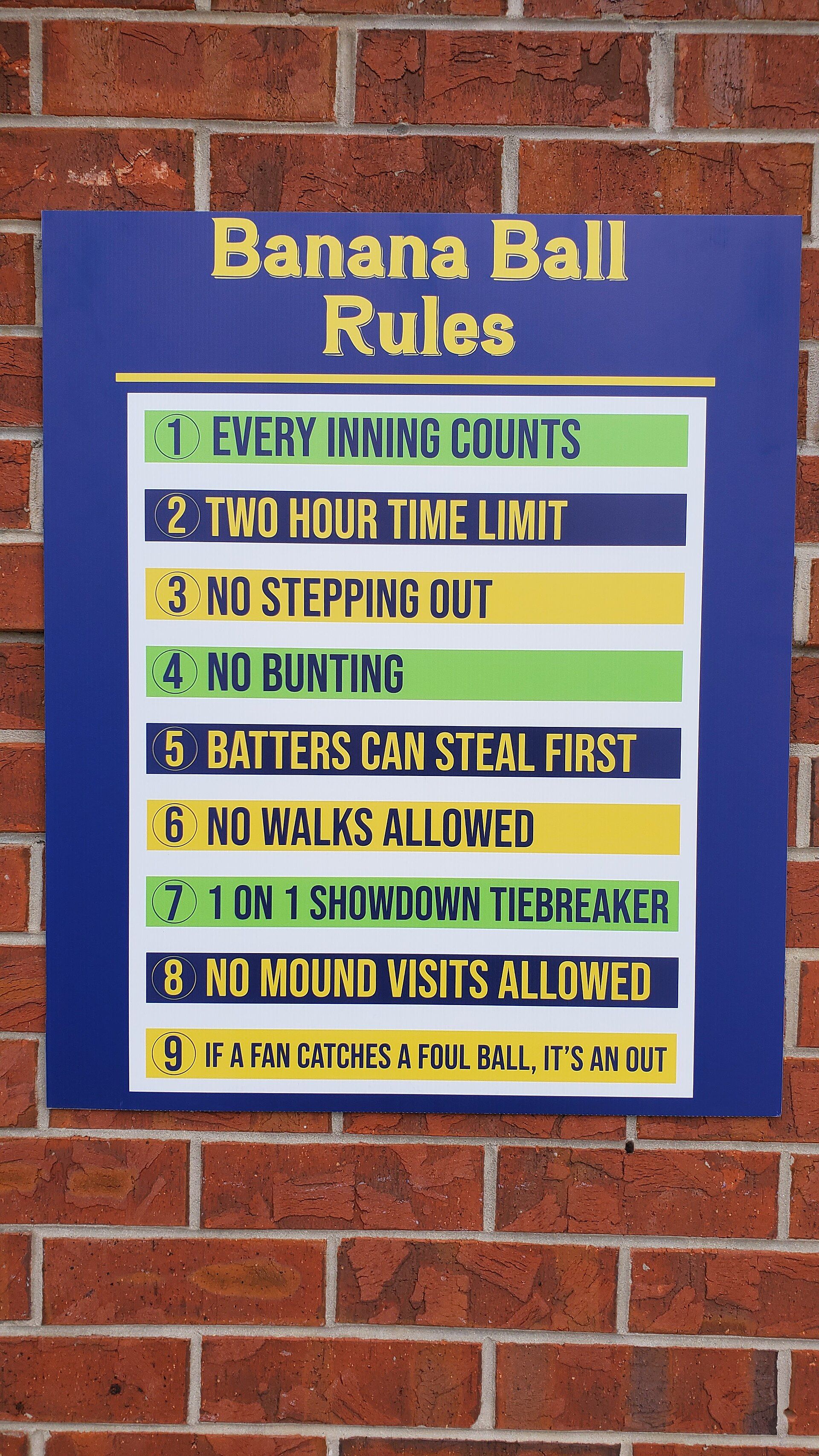
This is the part that trips up newcomers. In Major League Baseball, you win by scoring the most runs over nine innings. In Banana Ball, you win by winning innings.
The core rule is "win the inning, win the point." Every inning is worth exactly one point. Whichever team scores more runs in an inning grabs that point, and the standings are built on those points — not on total runs.
A few wrinkles make team records even more interesting:
- The final inning is different. In the last inning, every single run counts as a point, which keeps blowouts from ever feeling safe and sets up wild comebacks.
- Innings can end early. Once a team has scored enough to lock up an inning, that inning is over — no running up the score.
- Trick plays can earn a bonus point. If one team has pulled off more trick plays through eight innings, it banks an extra point heading into the ninth.
So when you look at a team's record, you're looking at a tally of innings won and games closed out — a measure of which squad performs best in those one-point battles, inning after inning. If a game ends tied, it goes to a showdown tiebreaker, a sudden, high-pressure mini-format where one swing can decide everything.
The teams behind the records
Those records belong to the six clubs in the Banana Ball Championship League: the Savannah Bananas, the Party Animals, the Firefighters, the Texas Tailgaters, the Loco Beach Coconuts, and the Indianapolis Clowns — the last a revival of the legendary barnstorming franchise. You can read up on each club's identity and roster on the Banana Ball teams page, and track how they stack up on the team stats page.
Because every team plays a full league slate, records build up over a season and the strongest clubs separate themselves over time. Win-loss records, points earned, and head-to-head results all feed into where a team lands in the table.
Player stats: what Banana Ball actually tracks
Here's the fun part. Banana Ball is a show first, but the players are genuinely elite athletes, and their numbers get tracked just like in any serious league. On the hitting side, you'll see the familiar stuff — hits, home runs, RBIs, batting average — plus the Banana Ball flavor that comes from rules built for offense and chaos.
A few things to keep in mind when you read a player's line:
- No walks means more swings. A "walk" in Banana Ball turns into a sprint — the batter takes off and every defender has to touch the ball before the play is dead, so the hitter can race for extra bases. That changes how on-base numbers look and rewards aggressive baserunning.
- Speed and baserunning matter more. With a faster clock and rules that reward daring, stolen bases and extra-base hustle show up in a way they rarely do elsewhere.
- Pitchers are entertainers and competitors. Velocity, strikeouts, and innings still count, but you'll also see signature deliveries and stunts that are part of the act.
The takeaway: a Banana Ball stat line rewards players who swing hard, run wild, and put on a show. Big counting numbers are common because the rules are designed to push the action forward instead of slowing it down.
Why the numbers look different from regular baseball
If you compare a Banana Ball box score to an MLB one, a few things jump out. Scores can look high because every run in the final inning matters. Game-level "records" are about innings won, not run totals. And because games run on a roughly two-hour clock, you won't see the marathon, extra-inning stat lines that pile up in traditional baseball.
None of that makes the stats less real — it just means you should read them in context. A player's value in Banana Ball is measured by how much energy and offense they create, not only by traditional rate stats.
Where to find live player stats and team records
The best stats are the current ones. You can pull up the latest individual leaders — hits, home runs, and more — on the Banana Ball player stats page, and check how the clubs compare on the team stats page. To see those numbers in motion as games happen, the teams page is the place to start before you dive into any single squad.
Bookmark those pages and the stats stop being a mystery — they become the running scorecard of the most entertaining league in baseball.
FAQ
How do team records work in Banana Ball?
Records are based on points, and points come from winning innings. Each inning is worth one point, the team with the most points wins the game, and in the final inning every run counts. Ties go to a showdown tiebreaker.
What player stats does Banana Ball track?
Banana Ball tracks the standard categories — hits, home runs, RBIs, batting average, stolen bases, strikeouts, and more — but the offense-friendly rules (like no walks and a sprint rule) tend to inflate baserunning and contact numbers compared to traditional baseball.
Why are Banana Ball stats different from MLB stats?
The rules change what the numbers mean. Winning happens by inning rather than by total runs, the final inning scores every run, and a roughly two-hour clock keeps games short. So the same stat can carry different weight than it would in a standard nine-inning game.
Where can I see live Banana Ball player stats and standings?
You can find current individual leaders on the player stats page, compare clubs on the team stats page, and explore each franchise on the teams page.
Photo: baseballmapper / Wikimedia Commons (CC0)
